
-
Evie Huang sales consultant
-
Email: Sales@matictest.com
-
Phone/WhatsApp: +86 18996117830
Secondary Water Supply Monitoring: Protecting Drinking Water at the Last Mile
Why treated water degrades between the plant and the tap, which parameters detect it, and how to design a monitoring system for storage tanks and booster stations in buildings and districts.
Water leaving a treatment plant usually meets specification. What arrives at the tap sometimes does not. The stretch in between — storage tanks, cisterns, booster pumps and building risers — is where water quality most often degrades, and it is the least monitored part of the whole supply chain. This guide explains why, what to measure, and how to design monitoring that actually works.
What Secondary Water Supply Means
Secondary water supply refers to the storage and pressure-boosting systems that sit between the municipal distribution network and the end user. In high-rise buildings, large campuses and districts where mains pressure is insufficient, water is held in tanks or cisterns and pumped to where it is needed.
Every one of those storage and pumping stages is a place where water quality can change. The water is no longer in a pressurised pipe travelling briskly to a consumer — it is sitting still, often in the dark, sometimes for hours or days.
Why Quality Degrades in Storage
Loss of Disinfectant Residual
This is the central mechanism. Water leaving the plant carries a disinfectant residual — free chlorine or chloramine — that protects it in transit. In storage, that residual decays through reaction with pipe walls, sediment and organic matter, and through simple time and temperature effects.
Once the residual falls too low, any bacteria present can regrow. Long residence times, warm tanks and low turnover all accelerate decay, which is why the problem is worst in summer and in tanks that are oversized for actual demand.
Residence Time and Stagnation
Residence time is the interval water spends in storage. Oversized tanks, low occupancy and poor turnover all lengthen it. Long residence means more disinfectant decay, more sediment settling and more opportunity for bacterial growth — and it also means temperature in the tank drifts toward ambient, further accelerating everything.
Sediment and Biofilm
Suspended particles settle in storage tanks and form a sediment layer that consumes disinfectant and shelters microorganisms. Biofilm on tank walls and pipework does the same, and is relatively protected from the disinfectant in the bulk water.
Contamination Pathways
- Backflow from a cross-connection when pressure is lost.
- Ingress through inadequately sealed access hatches, vents or overflows.
- Contaminated tank materials or coatings.
- Entry during maintenance or inspection.
- Rodent or insect access where screens are damaged.
What to Measure
| Parameter | What it detects | Why it matters here |
|---|---|---|
| Free chlorine / residual disinfectant | Disinfectant decay | The single most direct indicator of protective capacity remaining |
| Turbidity | Sediment disturbance, ingress | Responds quickly to contamination events |
| pH | Corrosion, chemical change | Affects disinfectant effectiveness and metal release |
| Conductivity | Contamination, cross-connection | Cheap, robust, sensitive to any dissolved ingress |
| Temperature | Context for everything else | Warm tanks decay faster and support more growth |
| Level / tank turnover | Residence time | Explains why the other parameters behave as they do |
Residual Chlorine Is the Anchor Measurement
If you measure only one parameter in secondary supply, measure residual disinfectant. It is the parameter that tells you whether the water is still protected, it responds to the dominant failure mechanism, and it is directly actionable: a falling residual means increase turnover, adjust dosing or investigate the tank.
Turbidity as a Fast Alarm
Turbidity responds within minutes to sediment disturbance and ingress events, making it an excellent alarm parameter even though it says nothing about microbiology directly. A sudden turbidity rise in a storage tank deserves immediate investigation.
Designing the Monitoring System
Where to Place Sensors
- Tank outlet / pump suction: Represents the water actually being delivered — the most meaningful compliance point.
- Tank inlet: Establishes the incoming baseline, letting you separate a supply problem from a storage problem.
- Representative building taps: Captures conditions in the riser and at the point of use, where stagnation in branch pipes adds its own effect.
- Loop return: In circulating systems, shows the condition of water returning to the tank.
A useful minimum for a building is one monitoring point at the tank outlet measuring residual, turbidity and pH, with conductivity and temperature included where budget allows.
Continuous versus Spot Measurement
Manual sampling gives an accurate snapshot but almost no coverage: a contamination event that lasts two hours between weekly visits is invisible. Continuous online monitoring trades a little absolute accuracy for complete temporal coverage — and in secondary supply, coverage is what matters, because the failure modes are intermittent.
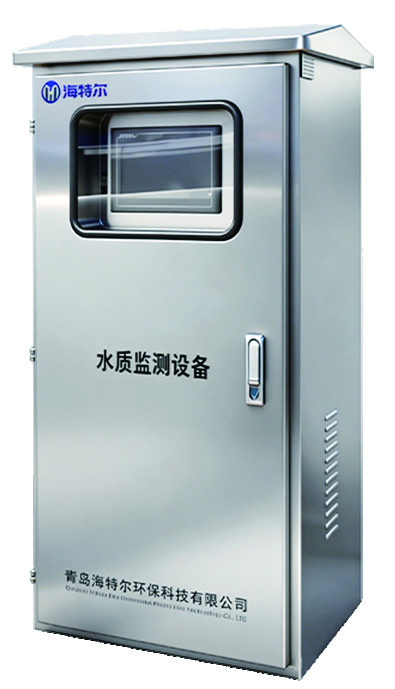
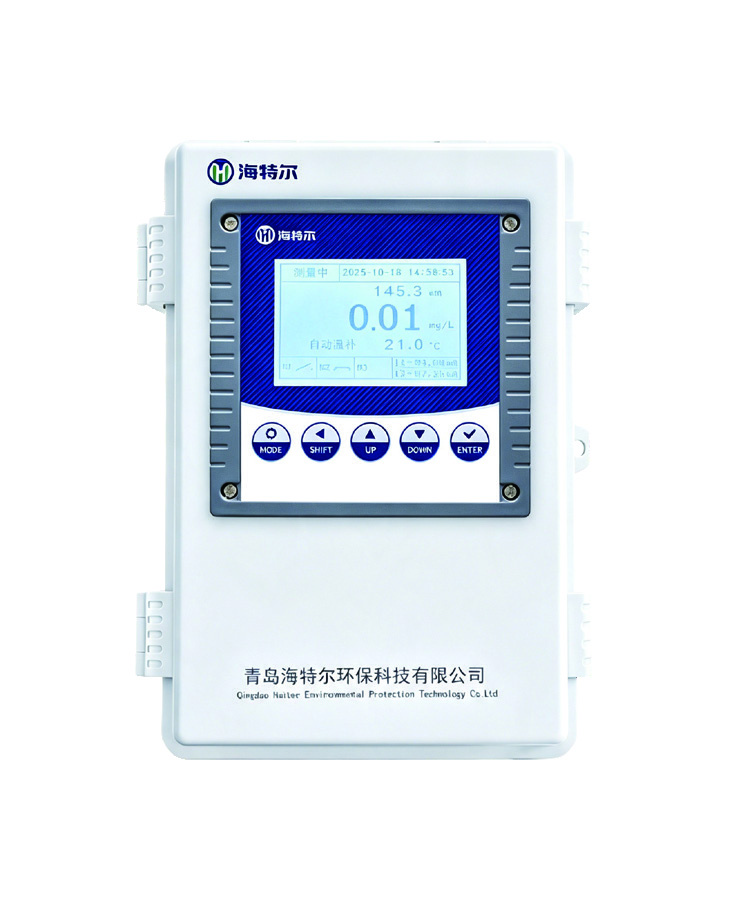
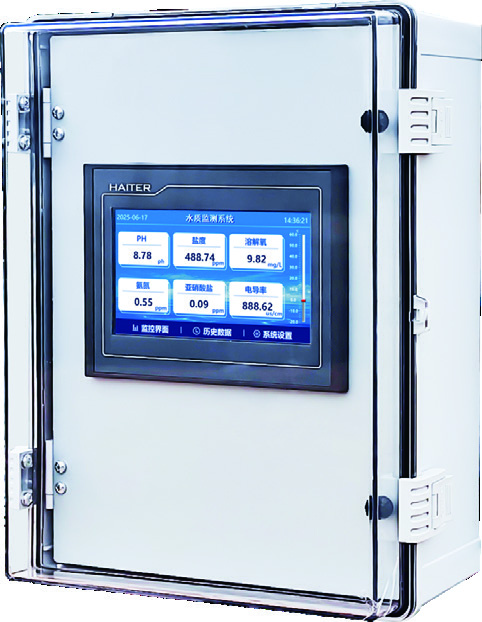
Multi-parameter instruments designed for this duty, such as wall-mounted and cabinet analysers covering pH, conductivity, dissolved oxygen, residual chlorine, turbidity and additional parameters, allow several measurements from one installation point — which suits plant rooms where space is tight.
Alarm Thresholds and Response
Thresholds should reflect both a limit and a duration, so that transient spikes do not create alarm fatigue:
| Condition | Typical response |
|---|---|
| Residual below lower limit, sustained | Investigate turnover and dosing; consider tank inspection |
| Turbidity spike | Check recent maintenance, inflow and tank integrity; consider flushing |
| pH drifting outside band | Investigate corrosion or chemical ingress |
| Conductivity step change | Suspect cross-connection or contamination; investigate immediately |
| Level indicating very low turnover | Review tank sizing and demand; consider operational change |
Operational Measures That Complement Monitoring
Instruments detect problems; operations prevent them. The measures with the greatest impact:
- Size tanks for actual demand — oversized tanks create long residence times.
- Keep turnover high — design and operate so that stored water is regularly refreshed.
- Insulate and shade tanks — lower temperature reduces decay and biological growth.
- Clean and inspect on a fixed schedule — remove sediment before it becomes a disinfectant sink.
- Seal and screen all openings — vents, overflows and access hatches.
- Prevent backflow — verify backflow prevention devices on all cross-connections.
- Manage stagnation in buildings — flush little-used outlets on a schedule.
Conclusion
Secondary water supply is the weakest link in many drinking water systems and the least instrumented. Monitoring it is not complicated: measure residual disinfectant continuously at the point of delivery, add turbidity and pH for fast detection and context, and pair the instruments with housekeeping that keeps residence time short and tanks clean. The plant may be doing its job perfectly — the question is whether the water still meets specification several hours and one storage tank later.
Frequently Asked Questions
Why monitor at all if the municipal supply is compliant?
Because compliance is measured at the plant or at defined network points, not at your tap. Everything that happens in storage and distribution — disinfectant decay, sediment, stagnation, cross-connections — occurs after that measurement point.
Is residual chlorine enough on its own?
It is the most important single parameter, but adding turbidity gives you fast detection of physical contamination events and pH gives context for corrosion and disinfectant effectiveness. Together the three cover the dominant failure modes.
How often should storage tanks be cleaned?
At least annually in most guidance, and more often where sediment accumulates quickly or temperatures are high. Monitoring data can support a risk-based interval: if turbidity and residual stay stable, intervals may be extended; if they degrade, shorten them.
What causes sudden turbidity spikes in a tank?
Common causes include disturbance of settled sediment by high inflow rates, recent maintenance or inspection activity, ingress through damaged seals or vents, and upstream events arriving in the supply.
Can monitoring replace manual testing?
No — they are complementary. Continuous online monitoring provides coverage and early warning; periodic laboratory testing provides verified compliance results and microbiological analysis that online sensors cannot deliver. Use both.
About Author

Hello, I'm Leno Zhang. I have 15 years of experience in the water quality monitoring industry, with extensive pre-sales and after-sales project experience. Our company specializes in integrated water quality monitoring stations, multi-parameter analyzers and smart sensors. I can assist customers in solving all practical on-site project challenges and provide the most suitable integrated solutions.
Tell Us Your Requirement
High Quality
Stable performance, IP-rated field design, accurate measurement and reliable data for 24/7 water quality monitoring in harsh environments.
Fast Delivery
Timely delivery to support your urgent orders and project schedules efficiently and professionally at any time.
Best Warranty
Professional Warranty: 12-month coverage plus long-term remote support for stable water quality monitoring and customer satisfaction.